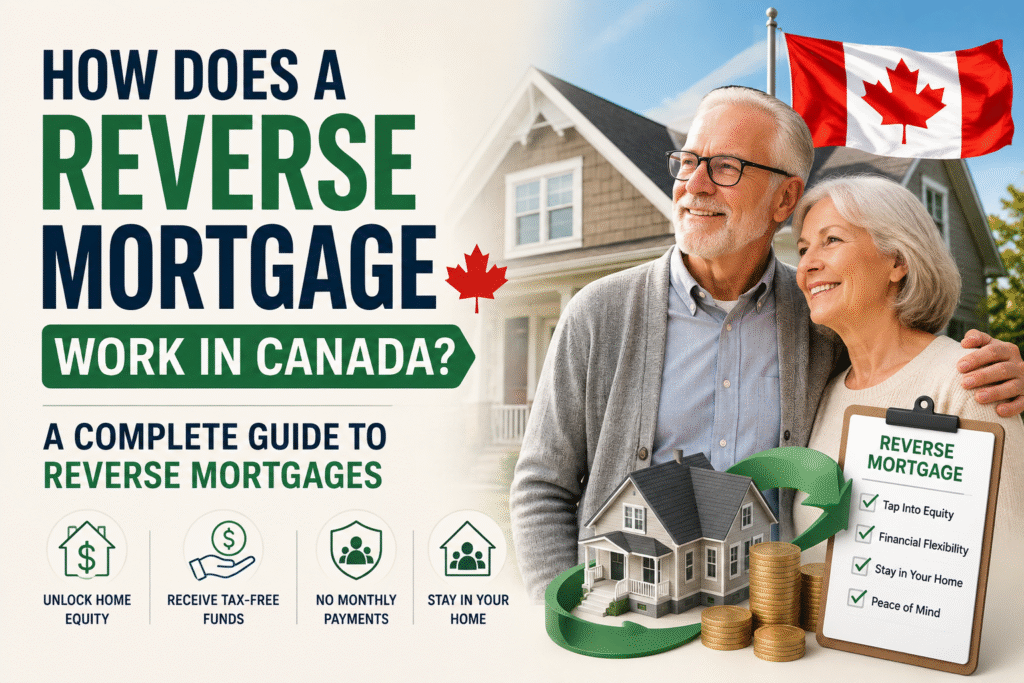
If you are a homeowner in Canada looking for ways to access money during retirement, you may have heard about reverse mortgages. But how does a reverse mortgage work in Canada, and is it the right option for you?
A reverse mortgage can help eligible Canadian homeowners access a portion of their home’s equity without selling their home or moving out. It can provide additional funds for retirement expenses, home renovations, debt repayment, healthcare costs, or other financial needs.
However, reverse mortgages also come with interest charges, fees, and important long-term considerations. In this guide, we will explain how reverse mortgages in Canada work, who can qualify, how much you may be able to borrow, the costs involved, and the advantages and disadvantages to consider before making a decision.
What Is a Reverse Mortgage in Canada?
A reverse mortgage is a type of home loan that allows eligible homeowners to borrow money using the equity in their home.
With a traditional mortgage, you make regular payments to reduce your loan balance. With a reverse mortgage, you generally do not have to make regular mortgage payments while you continue to meet the conditions of the loan.
Instead, interest is added to the outstanding balance over time. The reverse mortgage is generally repaid when you sell your home, move out, or the last borrower dies.
In Canada, reverse mortgages are generally available to homeowners aged 55 and older. The amount you can borrow depends on several factors, including your age, the value of your home, its condition, location, and the lender’s requirements.
How Does a Reverse Mortgage Work in Canada?
So, how does a reverse mortgage work in Canada?
The process is fairly simple. Instead of selling your home to access its equity, you borrow against a portion of that equity while continuing to live in your property.
Here is how the process generally works:
- Your home is assessed to determine its current market value.
- The lender reviews your eligibility, including your age, property value, property type, and other requirements.
- The lender determines how much you may be able to borrow.
- You choose how you want to receive the money, depending on the options offered by the lender.
- The reverse mortgage is registered against your home as a secured loan.
- Interest accumulates on the amount you borrow.
The loan is generally repaid when you sell the home, move out, or the last borrower dies.
One of the main benefits is that you can access home equity without having to sell your home.
How Much Can You Borrow With a Reverse Mortgage?
The amount you can borrow depends on your personal circumstances and the lender’s criteria.
Some of the factors that can affect the amount include:
- Your age
- The age of your spouse or co-borrower
- The current value of your home
- The condition and type of your property
- The location of your property
- The amount of equity you currently have
- The lender’s lending policies
In general, Canadian homeowners may be able to borrow up to 55% of the value of their home, although the actual amount available to you may be significantly lower.
For example, if your home is worth $600,000, you should not automatically assume that you can borrow $330,000. The lender will calculate the amount based on your age, property, and other factors.
It is important to get an individual estimate from a qualified lender before making financial decisions.
Who Qualifies for Reverse Mortgages in Canada?
Eligibility requirements can vary depending on the lender, but reverse mortgages in Canada are generally designed for homeowners aged 55 or older.
You may need to meet requirements such as:
- Being at least 55 years old
- Owning your home
- Using the property as your primary residence
- Having sufficient home equity
- Owning a property that meets the lender’s requirements
If you have an existing mortgage or other debt secured against your home, you may need to use some of the reverse mortgage proceeds to pay it off.
Because eligibility requirements vary, it is important to check the current requirements with the lender you are considering.
How Do You Receive Money From a Reverse Mortgage?
Depending on the lender and product, you may have different options for receiving your reverse mortgage funds.
These may include:
- Receiving a lump-sum payment
- Receiving money through multiple advances
- Combining an initial lump sum with future advances
The best option depends on why you need the money.
If you only need a specific amount for a home renovation or debt repayment, borrowing only what you need may help limit the amount of interest that accumulates over time.
What Can You Use a Reverse Mortgage For?
One of the benefits of a reverse mortgage is that the funds can generally be used for a variety of personal financial needs.
For example, homeowners may use the money to:
- Supplement retirement income
- Pay for home renovations
- Cover healthcare expenses
- Pay off existing debts
- Manage unexpected expenses
- Help family members financially
- Fund travel or lifestyle expenses
- Pay off an existing mortgage
However, you should always review your specific loan agreement to understand whether any restrictions apply.
Do You Still Own Your Home With a Reverse Mortgage?
Yes. Taking out a reverse mortgage does not mean that you give ownership of your home to the lender.
You remain the homeowner and can generally continue living in your property as long as you meet the requirements of your agreement.
However, the reverse mortgage is secured against your home. You are still responsible for expenses and obligations such as property taxes, home insurance, and maintaining the property.
Failing to meet these obligations could potentially cause problems with your loan.
Do You Have to Make Monthly Payments?
One of the biggest differences between a reverse mortgage and a traditional mortgage is that you generally do not have to make regular mortgage payments.
Instead, interest accumulates and is added to your loan balance.
For example, imagine you borrow $200,000 through a reverse mortgage. If you do not make payments toward the loan, the balance can grow over time because interest is added.
This can make a reverse mortgage attractive to retirees who have significant home equity but do not want another monthly payment.
However, it is important to remember that no monthly payment does not mean no cost. The interest still needs to be paid eventually.
What Does a Reverse Mortgage Cost in Canada?
Before choosing a reverse mortgage, you should understand all of the costs involved.
Potential costs may include:
- Interest charges
- Home appraisal fees
- Legal fees
- Administration fees
- Closing costs
- Potential prepayment charges
Reverse mortgage interest rates are generally higher than rates for traditional mortgages or home equity lines of credit.
Because interest accumulates over time, the total amount owed can become significantly larger than the amount you originally borrowed.
For this reason, it is important to compare the interest rate, fees, and repayment conditions before choosing a lender.
What Happens When You Sell Your Home?
If you decide to sell your home, the reverse mortgage will generally need to be repaid.
The money from the sale can be used to repay the outstanding reverse mortgage balance, including accumulated interest and applicable fees.
Any remaining equity can generally stay with you after the loan and other applicable debts and selling costs have been paid.
For example, suppose you sell your home for $700,000 and the reverse mortgage balance is $300,000.
Approximately $400,000 would remain before considering other applicable selling expenses, taxes, or debts.
What Happens to a Reverse Mortgage When You Die?
A reverse mortgage generally becomes repayable when the last borrower dies.
The estate or beneficiaries may have the option to repay the outstanding balance using other funds or by selling the property.
If the home is sold, the proceeds can be used to repay the reverse mortgage.
This is an important consideration for homeowners who want to leave their property or home equity to their children or other beneficiaries.
The longer the reverse mortgage remains outstanding, the more interest may accumulate, which can reduce the amount of equity remaining in the estate.
Does a Reverse Mortgage Affect Government Benefits?
Reverse mortgage proceeds are generally considered borrowed money rather than employment or investment income.
According to the Financial Consumer Agency of Canada, money borrowed through a reverse mortgage does not affect Old Age Security or Guaranteed Income Supplement benefits.
However, everyone’s financial situation is different. If government benefits are an important part of your retirement income, consider speaking with a qualified financial professional before taking out a reverse mortgage.
Reverse Mortgage vs. HELOC
A home equity line of credit, commonly known as a HELOC, is another way to access the equity in your home.
However, there are important differences between a HELOC and a reverse mortgage.
Reverse Mortgage:
- Generally available to homeowners aged 55 or older
- Regular mortgage payments are generally not required
- Interest accumulates on the outstanding balance
- May allow access to a portion of your home equity
- Can be useful for homeowners with limited monthly income
HELOC:
- Age requirements vary by lender
- Regular payments are generally required
- Interest is charged on the amount borrowed
- May provide a lower interest rate than a reverse mortgage
- Qualification can depend on income, credit, and other financial factors
A HELOC may be less expensive in some situations, but not everyone will qualify. Comparing both options can help you determine which type of borrowing better fits your circumstances.
Advantages of Reverse Mortgages in Canada
There are several potential advantages to choosing a reverse mortgage.
- Access Your Home Equity
- A reverse mortgage allows you to access money tied up in your home without selling the property.
- Stay in Your Home
- You can generally continue living in your home while accessing part of its equity.
- No Regular Mortgage Payments
- You generally do not have to make regular mortgage payments, which can help homeowners manage monthly retirement expenses.
- Flexible Use of Funds
- The money can generally be used for a variety of personal financial needs.
- Potentially No Impact on OAS or GIS
Reverse mortgage proceeds generally do not count as taxable income and do not affect OAS or GIS benefits, according to the Financial Consumer Agency of Canada.
Disadvantages of Reverse Mortgages in Canada
Despite the benefits, there are also potential disadvantages.
- Higher Interest Rates
- Reverse mortgage interest rates are generally higher than traditional mortgage or HELOC rates.
- Growing Loan Balance
- If you do not make payments, interest continues to accumulate, increasing the amount you owe.
- Reduced Home Equity
- As your loan balance grows, the amount of equity remaining in your home may decrease.
- Less Money for Your Estate
- A larger reverse mortgage balance can mean less home equity remains for your beneficiaries.
- Fees and Other Costs
- Appraisal, legal, administration, and other fees can increase the total cost of borrowing.
- Potential Effect on Future Financing
Having a reverse mortgage may limit your ability to use other types of financing secured against your home.
Are Reverse Mortgages Safe?
Reverse mortgages are legitimate financial products in Canada, but that does not mean they are the right choice for every homeowner.
Before signing a reverse mortgage agreement, make sure you understand:
- The interest rate
- Whether the interest rate can change
- All fees and charges
- How interest is calculated
- Prepayment rules
- What happens if you move
- What happens when the last borrower dies
- Your responsibilities for property taxes and insurance
- How the loan could affect your estate
- You should also compare a reverse mortgage with other options before making a final decision.
Alternatives to Reverse Mortgages
A reverse mortgage is only one way to access home equity.
Depending on your financial situation, you may also consider:
- Home equity lines of credit
- Home equity loans
- Refinancing
- Downsizing to a smaller property
- Selling your home
- Using retirement savings
- Other retirement income strategies
Each option has different costs, eligibility requirements, and financial consequences.
How to Apply for a Reverse Mortgage in Canada
If you decide that a reverse mortgage may be right for you, the application process generally includes several steps.
Step 1: Review Your Financial Needs
Determine how much money you need and what you plan to use it for.
Step 2: Estimate Your Home’s Value
Find out approximately how much your home is worth and calculate how much equity you have.
Step 3: Compare Lenders
Compare interest rates, fees, borrowing limits, payout options, and repayment conditions.
Step 4: Complete a Property Appraisal
The lender may require a professional appraisal to determine the current value of your property.
Step 5: Review the Loan Agreement
Carefully review the interest rate, fees, repayment requirements, and other terms.
Step 6: Consider Professional Advice
A financial advisor or lawyer can help you understand the long-term impact of the reverse mortgage on your finances and estate.
Is a Reverse Mortgage Right for You?
A reverse mortgage may be worth considering if you are a homeowner aged 55 or older, have significant home equity, and want to access money without selling your home.
It may be particularly useful if you want to supplement your retirement income, pay for major expenses, or reduce financial pressure without taking on another regular monthly payment.
However, a reverse mortgage may not be the best option if minimizing interest costs or preserving home equity for your beneficiaries is your main priority.
The right choice depends on your income, savings, home equity, financial goals, and long-term plans.
Frequently Asked Questions
How does a reverse mortgage work in Canada?
A reverse mortgage allows eligible homeowners to borrow against a portion of their home’s equity while continuing to live in the property. Regular mortgage payments are generally not required, but interest accumulates on the loan balance. The loan is generally repaid when the homeowner sells the property, moves out, or the last borrower dies.
How much can you borrow with a reverse mortgage in Canada?
The amount you can borrow depends on factors such as your age, home value, property type, location, and lender requirements. Homeowners may generally be able to access up to 55% of their home’s value, although the actual amount can be lower.
Do I still own my home with a reverse mortgage?
Yes. You generally retain ownership of your home as long as you meet the terms and conditions of the reverse mortgage agreement.
Do reverse mortgages require monthly payments?
Generally, regular mortgage payments are not required. However, interest accumulates over time and increases the outstanding loan balance.
Can I use reverse mortgage money for any purpose?
In most cases, borrowers can use the funds for a variety of personal expenses. However, specific rules can vary by lender, so always review your loan agreement.
What happens to a reverse mortgage when I die?
When the last borrower dies, the reverse mortgage generally becomes due. The estate may repay the loan or sell the property to repay the outstanding balance.
Are reverse mortgage proceeds taxable?
Reverse mortgage proceeds are generally considered loan proceeds rather than taxable income. They are not treated like employment or investment income.
Is a reverse mortgage better than a HELOC?
It depends on your circumstances. A reverse mortgage may be suitable for homeowners who want to access home equity without regular mortgage payments. A HELOC may have lower borrowing costs but generally requires borrowers to meet the lender’s qualification requirements and make payments.
Final Thoughts
Understanding how does a reverse mortgage work in Canada is important before using your home equity to fund retirement or other financial needs.
Reverse mortgages in Canada can provide eligible homeowners with access to home equity while allowing them to remain in their homes. They can be useful for supplementing retirement income, paying major expenses, or managing financial needs without selling the property.
However, reverse mortgages also come with higher interest rates, fees, and the potential for the loan balance to grow over time.
Before making a decision, compare different lenders and alternatives, understand the total cost of borrowing, and consider how the loan could affect your future finances and estate.
A reverse mortgage can be a valuable financial tool for some Canadian homeowners, but it should be considered as part of a broader retirement and financial plan.